

The Carbon Footprint of Artificial Intelligence: Managing the Environmental Cost of Digital Transformation
Artificial Intelligence (AI) is redefining how organizations operate. From predictive maintenance and supply chain optimization to climate modeling and ESG data analytics, AI is increasingly embedded in corporate strategy. It promises efficiency, innovation, and smarter decision-making.
Yet behind this digital transformation lies a growing environmental cost: AI has a carbon footprint and it is expanding rapidly. For ESG leaders, boards, and sustainability professionals, the environmental implications of AI can no longer be overlooked. Responsible digital transformation must now include carbon-conscious AI governance.
The Hidden Energy Demand Behind AI
Modern AI systems, particularly large-scale machine learning and generative models require significant computational power. Training advanced models involves processing vast datasets across high-performance computing infrastructure, often running continuously for days or weeks. This computational intensity translates into substantial electricity consumption.
The environmental impact depends on several factors:
- The size and complexity of the model
- The duration and frequency of training
- The efficiency of hardware (GPUs, TPUs, cooling systems)
- The carbon intensity of the electricity grid powering the infrastructure
While exact figures vary, large AI model training runs can consume thousands of megawatt-hours of electricity. Even after deployment, AI systems continue to generate emissions through ongoing use, updates, and cloud-hosted operations. For example, training GPT-4 consumed approximately 50 gigawatt-hours, enough to power around 27,000 Kenyan households, serving approximately 100,000 people for an entire year. In 2024, AI systems worldwide consumed approximately 415 terawatt-hours of electricity. If AI continues to grow, and it will, it is projected to surpass 1,000TWh by 2030, similar to the entire electricity demand of Japan today.
As AI adoption accelerates across industries, its cumulative energy demand is projected to grow significantly, placing additional pressure on global electricity systems.
The Paradox: AI as Both Problem and Solution
AI is not inherently unsustainable. In fact, it is increasingly deployed as a climate solution:
- Optimizing renewable energy integration
- Enhancing grid efficiency
- Improving agricultural productivity
- Strengthening climate risk modeling
- Supporting ESG data management and reporting
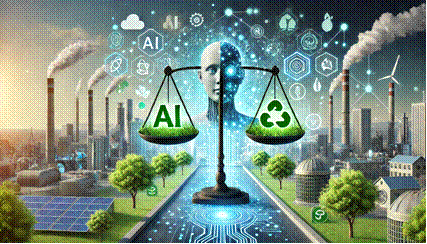
The paradox is clear: AI can accelerate decarbonization, while simultaneously increasing emissions if deployed irresponsibly. This duality underscores the need for deliberate governance.
Sustainable AI: From Awareness to Action
Organizations can take practical steps to reduce the carbon intensity of their AI systems.
1. Energy-Efficient Model Design
Not every problem requires the largest model available. Smaller, optimized models often deliver comparable performance at a fraction of the energy cost. Model efficiency should become a design principle, not an afterthought.
2. Renewable-Powered Cloud Procurement
Selecting cloud providers with strong renewable energy commitments can significantly reduce indirect emissions. Sustainability performance should be embedded in digital procurement criteria. For example, the planned Microsoft + G42 green data center campus at the Olkaria Green Energy Park effectively links Olkaria’s renewable energy with AI computing demand.
3. Digital Emissions Tracking
Organizations should begin measuring the carbon footprint of digital infrastructure, including AI systems within broader ESG reporting frameworks.
4. Governance Integration
AI oversight should extend beyond ethics and data privacy. Environmental impact assessments should form part of AI governance structures and board-level discussions.
Conclusion
AI will continue to shape the future of business. Its productivity and analytical advantages are too significant to ignore. However, innovation without environmental accountability risks undermining corporate climate commitments. The path forward is not to slow digital transformation, but to align it with sustainability strategy.
In an era defined by both technological acceleration and climate urgency, sustainable AI is not optional, it is a strategic necessity








Very relevant and timely content. Appreciate you sharing this.
Such a refreshing take on a common topic.
This is exactly the kind of content I’ve been searching for.
This was very well laid out and easy to follow.
The way you write feels personal and authentic.
I love how clearly you explained everything. Thanks for this.
I appreciate the depth and clarity of this post.
I agree with your point of view and found this very insightful.
Thank you for sharing this! I really enjoyed reading your perspective.
You clearly know your stuff. Great job on this article.
It’s great to see someone explain this so clearly.
This post gave me a new perspective I hadn’t considered.
I enjoyed every paragraph. Thank you for this.
I enjoyed every paragraph. Thank you for this.
This was a very informative post. I appreciate the time you took to write it.
Thank you for making this topic less intimidating.
So simple, yet so impactful. Well written!
I like how you kept it informative without being too technical.
This is one of the best explanations I’ve read on this topic.
Great job simplifying something so complex.
This was really well done. I can tell a lot of thought went into making it clear and user-friendly. Keep up the good work!
You bring a fresh voice to a well-covered topic.
Such a simple yet powerful message. Thanks for this.
You’ve sparked my interest in this topic.
You always deliver high-quality information. Thanks again!
I appreciate the real-life examples you added. They made it relatable.
You’ve sparked my interest in this topic.
I enjoyed your take on this subject. Keep writing!
You have a real gift for explaining things.
Your passion for the topic really shines through.
This made me rethink some of my assumptions. Really valuable post.
Thank you for sharing this! I really enjoyed reading your perspective.
It’s refreshing to find something that feels honest and genuinely useful. Thanks for sharing your knowledge in such a clear way.
Your articles always leave me thinking.
I appreciate your unique perspective on this.
I agree with your point of view and found this very insightful.
What I really liked is how easy this was to follow. Even for someone who’s not super tech-savvy, it made perfect sense.
You’ve clearly done your research, and it shows.
Thanks for sharing your knowledge. This added a lot of value to my day.
So simple, yet so impactful. Well written!
This content is really helpful, especially for beginners like me.
I really needed this today. Thank you for writing it.
Your content always adds value to my day.
I love how practical and realistic your tips are.
Keep educating and inspiring others with posts like this.
This post cleared up so many questions for me.
Such a refreshing take on a common topic.
Thanks for making this easy to understand even without a background in it.
You explained it in such a relatable way. Well done!
无话可说,只是看看
You really know how to connect with your readers.
I appreciate the depth and clarity of this post.
I’ve gained a much better understanding thanks to this post.
Such a simple yet powerful message. Thanks for this.
I enjoyed your perspective on this topic. Looking forward to more content.
This gave me a whole new perspective. Thanks for opening my eyes.
Wish you happiness
yahoo,im go
Hahahaha You are so good