

Integrative ESG, Sustainability, and Carbon Accounting Frameworks
Sustainability and ESG reporting now require integrated frameworks that link environmental data (especially carbon) with social and governance metrics. Companies often consolidate multiple standards and tools so that “carbon accounting recommendations across different ESG frameworks and standards” are aligned. For example, climate-focused frameworks like the TCFD (Task Force on Climate-Related Financial Disclosures) are being built into broader reporting rules such as the EU Taxonomy, CSRD and proposed U.S. SEC rules – all of which emphasize transparent GHG tracking.
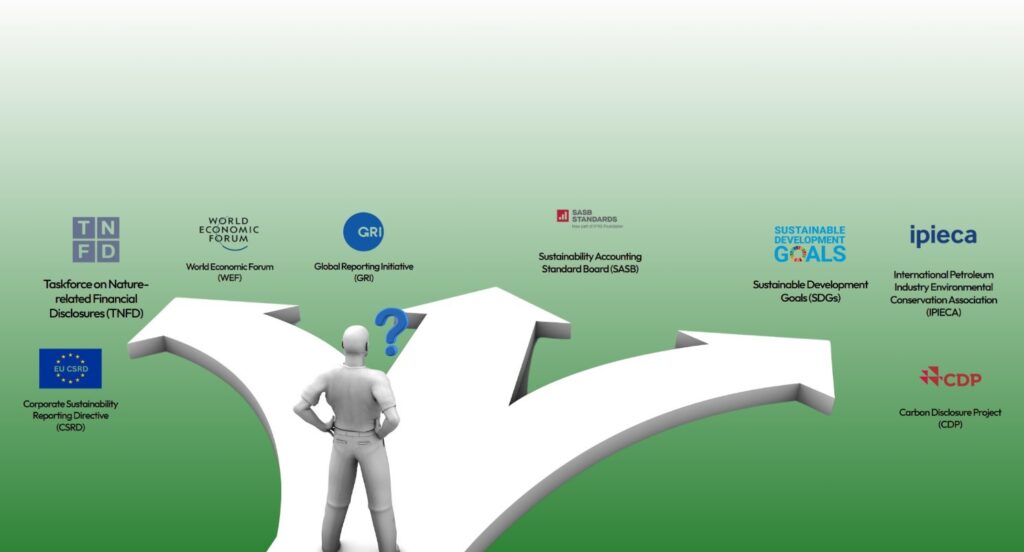
Companies ought to consider carbon disclosures in both “financial materiality and impacts on the environment and people,” a concept known as double materiality.
Embedding a sustainability mindset into core controls is the next step to make climate data as reliable as financial data. Integrated ESG frameworks apply structured tools (frameworks, standards, protocols) to measure financial and non-financial performance together.
In practice, frameworks provide the ‘why’ (guiding principles), standards set the ‘what’ (reporting requirements), and protocols detail the ‘how’ (specific methodologies) for effective sustainability reporting.
For example, industry guides categorize disclosures into frameworks (high-level guidance like the Integrated Reporting Framework, standards (detailed metrics like GRI Standards), and protocols (specific methods like the GHG Protocol).
Key ESG and Sustainability Reporting Frameworks
- Global Reporting Initiative (GRI) – A comprehensive standard set covering all ESG topics (from emissions to labor practices). GRI requires reporting on environmental impacts (including Scope 1, 2, 3 emissions under GRI 305) as part of a broad multi-stakeholder approach.
- SASB/ISSB Standards – Industry-specific standards focused on financially material ESG issues. SASB (now under the IFRS umbrella) provides sector metrics (including environmental ones) that feed into annual financial reports. The ISSB’s new IFRS S1/S2 standards build on TCFD and SASB to require climate and sustainability disclosures alongside financial statements.
- TCFD/ESRS/CDP – Climate disclosure frameworks: TCFD is now mandated by many regulators (EU, UK, NZ, etc.), requiring climate-risk governance and Scope 1–3 emission reporting. CDP (formerly Carbon Disclosure Project) provides a questionnaire aligned with TCFD and focuses on climate, water, and forests. In the EU, the CSRD/ESRS regime will force detailed ESG reporting (including GHG) in annual reports, structured under European Sustainability Reporting Standards.
Framework Convergence – Many organizations now map metrics across these frameworks. For example, an EU filer might use the GHG Protocol methodology to calculate emissions (Scope 1–3) and then report them according to GRI, TCFD/ISSB, and ESRS categories.
Leading frameworks (GRI, CSRD, SASB/ISSB, etc.) all encourage dual reporting of energy emissions (market- and location-based) to ensure transparency. In sum, major frameworks emphasize the same core data (like CO₂e) but present it to different audiences (investors, regulators, NGOs) as part of an integrated reporting system.
Carbon Accounting Standards and Protocols
- GHG Protocol – The dominant international standard for corporate GHG accounting. It defines Scope 1 (direct), Scope 2 (purchased energy) and Scope 3 (value-chain) emissions and provides detailed calculation guidance.
- ISO 14064 – A formal ISO standard specifying requirements for quantifying and verifying GHG emissions at organizational and project levels. Unlike the guidance-based GHG Protocol, ISO 14064 is a normative standard often used for formal certification. ISO 14064’s three parts (organization-level accounting, project-level, and verification) ensure data quality and comparability for carbon disclosures.
- Other Protocols – Specialized carbon tools help implement these standards. For example, the Science Based Targets initiative (SBTi) provides a framework to set climate targets in line with the Paris Agreement, while sector protocols like the Carbon Accounting Financials (PCAF) standardize financed (Scope 3) emissions for banks and investors. Crucially, these carbon standards integrate with broader ESG reporting: companies often report the same GHG inventory to regulators (via ISO/CSRD) and to investors (via TCFD/ISSB) using these common protocols.
Performance Metrics and KPIs – In practice, firms turn these standards into targets and KPIs. For example, a company might embed annual emissions reductions (from GHG Protocol data) into its Balanced Scorecard or strategy map, alongside social/governance objectives. This links carbon accounting directly to managerial performance metrics – turning disparate ESG data into a unified management framework (a Sustainability Balanced Scorecard).
Integrated Reporting and Management Models
Rather than siloed sustainability reports, organizations ought to integrate ESG data into core strategy and financial planning. The IFRS/ISSB model exemplifies this: its new standards require reporting climate and other ESG risks “over the short, medium and long term” in the same filings as financial results. In effect, carbon costs and emission targets are woven into budgets, forecasts, and capital allocation decisions. Similarly, firms are adapting management frameworks: for example, the COSO Internal Control–Integrated Framework (originally for financials) has a new Sustainability supplement. COSO’s guidance shows companies how to apply familiar control principles to ESG data, ensuring that carbon and sustainability metrics are as reliable as revenue numbers.
Regulatory and Policy Integration
Mandatory regulations are binding these elements together. The EU’s CSRD not only mandates climate disclosures but explicitly ties them to the corporate governance and management report. This creates a system where carbon accounting (underpinned by GHG Protocol or ISO rules) is legally integrated into annual financial filings alongside governance disclosures. Similarly, new U.S. proposals (SEC climate rules, California’s SB 253/261) will require Scope 1–3 emissions and climate risk reporting for large companies. These regulations essentially codify integrated ESG frameworks: firms must use recognized standards (GHG Protocol/ISO) to measure emissions and then disclose them following TCFD/ISSB-style formats, ensuring a coherent system from data collection to public reporting. For example, an EU energy firm might calculate emissions via ISO 14064, report them via GRI, and tie the results to investor disclosures via TCFD/ISSB.
Conclusion
Modern corporate reporting and planning increasingly rely on linked frameworks that span ESG and carbon. Frameworks like GRI, SASB/ISSB and TCFD set principles for what to disclose, protocols like ISO 14064 and GHG Protocol define how to measure carbon, and corporate models (Integrated Reporting, Balanced Scorecards, COSO ICSR) ensure that these disclosures inform strategy and controls. By embedding carbon accounting within holistic sustainability frameworks, companies can align environmental targets with social and financial goals in a single coherent system.







I would bookmark this page for chill guy clicker 3d. It is useful when you want to replay the game or send it to someone else.
Fun Clicker Fanmade Extension Chapter 1 Foundation is one of those games that feels better once you get into the loop. Definitely worth opening for a quick run.
I tried fun clicker fanmade extension chapter 1 foundation and it is a fun little clicker game. The page opens quickly and the gameplay is easy to get into.